
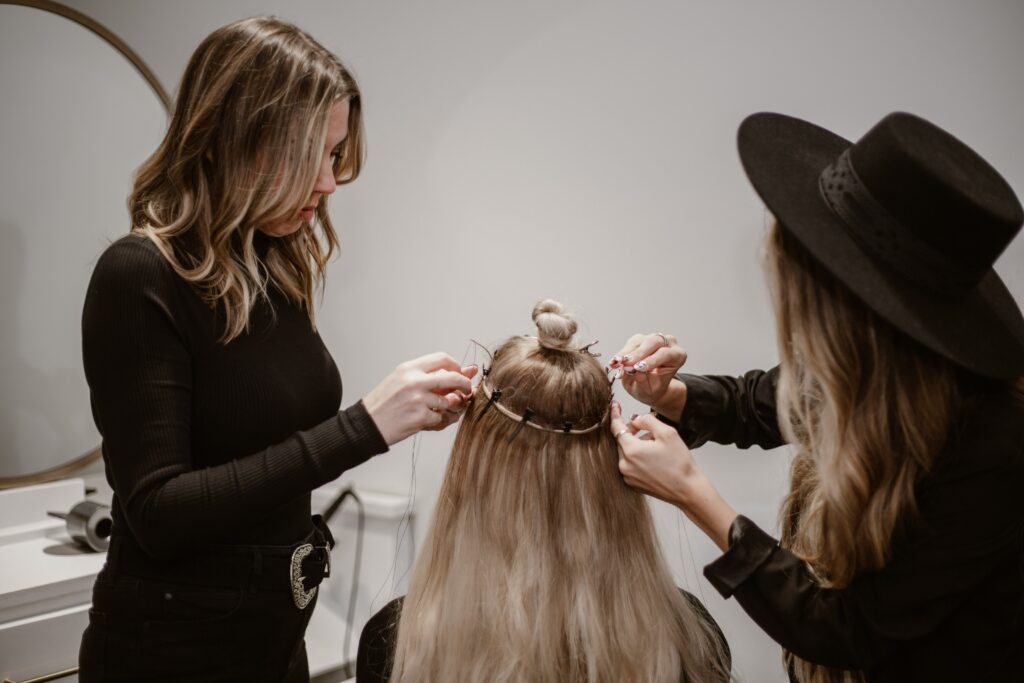

Choosing the Right Hair-Restoration Method for the Hair You Have Now
When women begin experiencing hair loss or reduced density, one of the first questions is often:
“What can I add?”
That is understandable.
When something feels missing, we naturally think about replacement.
But I usually start with a different question:
What can your natural hair safely support?
That one question can completely change the plan.
Because extensions, toppers and meshless integration are not interchangeable.
They solve different problems.
Extensions are designed to add length and density
Hair extensions can be beautiful for the right client.
They can increase length.
They can increase volume.
They can create fullness through areas where the natural hair remains strong enough to support the attachment method.
But extensions still depend on the natural hair.
That matters.
If density is significantly reduced through the top or crown, traditional extensions may not solve the visibility problem.
And if the natural hair is too fragile, adding more weight or repeated tension may be inappropriate.
Dermatologists warn that repeated pulling from extensions and other tight hairstyles can contribute to traction alopecia. If tension continues, the hair loss can become permanent.
American Academy of Dermatology
So I do not believe that “more extensions” is automatically the answer to thinning hair.
Sometimes it is.
Sometimes it is exactly the wrong direction.
What is a topper?
A topper is designed primarily to add coverage and density through the top portion of the head.
Depending on the design, it may cover areas such as:
- The part
- Crown
- Top
- Front
- Temple transition
- Diffuse thinning areas
A custom topper can be cut, colored, toned and blended into the natural hair.
That means it does not need to look like a separate piece sitting on the head.
When it is selected and customized correctly, it becomes part of the hairstyle.
For a woman whose primary concern is reduced density through the top rather than lack of length, a topper may make much more sense than traditional extensions.
What is meshless integration?
Meshless integration creates a foundation within the natural hair that allows a topper or hair system to be integrated with the client’s existing hair.
Unlike a removable topper, the integrated piece is designed to remain in place between maintenance appointments.
It can provide substantial density and coverage while allowing some of the natural hair to remain incorporated into the style.
For the right client, this can be transformative.
But it is still not appropriate for everyone.
Because the system relies on areas of natural hair for support, we need to be honest about the strength, density and condition of that hair.
If the natural hair cannot safely support the system, we do not force it.
That principle matters more to me than selling a particular method.
How I think through the options
When I evaluate restoration options, I am looking at several things together.
WHERE IS THE DENSITY LOSS?
If the primary issue is through the top and crown, a topper may provide coverage that extensions simply cannot.
If the natural hair is dense through the top but lacks fullness through the lengths, extensions may be ideal.
If the client needs ongoing top coverage but wants an integrated option, meshless integration may become part of the conversation.
HOW STRONG IS THE NATURAL HAIR?
The amount of remaining hair is not the only issue.
The quality of the remaining hair matters too.
Fragile strands may not be appropriate anchors simply because they are technically present.
WHAT IS THE CLIENT’S LIFESTYLE?
Some women love a removable topper because they want control.
Others do not want to put a piece on each morning.
Some want a semi-permanent integrated system.
Others want extensions because their biggest concern is length and fullness rather than top coverage.
There is no one “best” answer.
WHAT MAINTENANCE CAN THE CLIENT REALISTICALLY COMMIT TO?
A beautiful system that is not properly maintained can quickly become the wrong system.
Maintenance frequency, home care, styling habits and budget all matter.
Pain is not part of the process
This deserves its own section.
If extensions or an integrated system cause persistent pain, headache or excessive tension, that is not something I want a client to simply tolerate.
The American Academy of Dermatology specifically advises that if extensions or a weave feel painful or too tight, the tension should be addressed because repeated pulling can damage the natural hair.
American Academy of Dermatology
A restoration system should improve how you feel about your hair.
It should not sacrifice the remaining hair to do it.
Color is part of the restoration system
A topper or integrated piece is only as convincing as the customization around it.
That includes:
- Base color
- Gray percentage
- Highlights
- Lowlights
- Rooting
- Tonal balance
- Texture
- Cut
- Density
This is why I see my color background as a major part of hair restoration.
Sometimes a stock piece gets us close.
Then the real work begins.
Sometimes the right option changes over time
This is another concept I want clients to understand.
You may wear extensions successfully for years.
Then density changes.
A topper may become more appropriate.
Later, you may want an integrated system.
Or medical treatment may improve the natural hair enough that the restoration plan changes again.
There is nothing wrong with that.
Hair restoration is not a lifetime contract with one method.
It is a response to the hair you have now.
When medical evaluation matters
If hair loss is sudden, unexplained, painful, patchy, inflamed or rapidly progressing, restoration should not substitute for diagnosis.
Female-pattern hair loss, traction alopecia, alopecia areata, scarring alopecias and temporary shedding can look very different but may overlap visually. The AAD recommends professional medical diagnosis because different causes require different treatment.
American Academy of Dermatology
My role is to help with the cosmetic restoration side and recognize when something falls outside that lane.
My rule at Shear Underground
I do not want to sell you the most expensive method.
I do not want to sell you the trendiest method.
And I do not want to install something just because I technically can.
I want to choose the method your hair can support.
That might be:
Extensions.
A custom topper.
Meshless integration.
Another hairpiece.
Or sometimes:
Nothing added yet.
The hair makes the decision with us.
Start with a restoration consultation
A consultation allows us to look at density, location of thinning, scalp visibility, color, maintenance expectations and the condition of the natural hair before deciding what belongs on your head.